Thermal Fatigue and Mechanical Stress in Glass Shearing: Engineering Multi-Gob Carbide Shear Blades
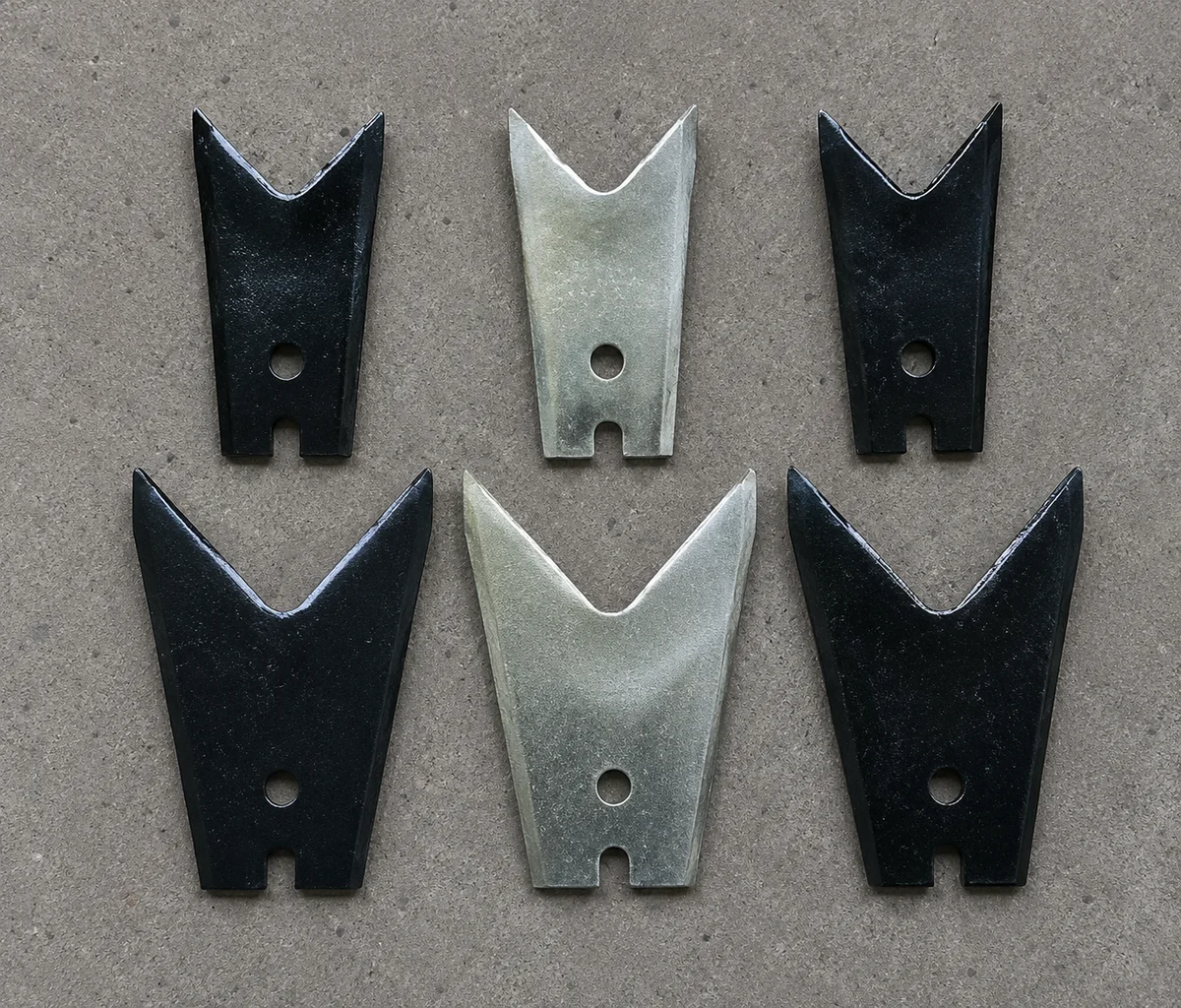
An engineering analysis of thermal fatigue and mechanical stress in container glass shearing. Learn about multi-gob carbide shear blade design, heat dissipation, and edge retention.
In high-speed glass container manufacturing, the Individual Section (IS) machine relies on the continuous, uninterrupted delivery of thermally homogeneous glass gobs. As production demands have escalated, glass plants have transitioned from single-gob to double-gob, triple-gob, and even quad-gob configurations.
This transition exponentially increases the mechanical and thermal load on the shear blade for container glass. In a triple-gob setup operating at 180 cuts per minute, the shear blades perform over 250,000 cuts per 24-hour cycle. Each cut exposes the blade edge to molten glass at 1,150°C (2,102°F) for approximately 10 to 15 milliseconds, immediately followed by a high-pressure water-lubricant spray that cools the blade back to under 150°C.
This extreme cyclic thermal shock leads to thermal fatigue (crazing), while the high-frequency impact induces severe mechanical stress.
1. The Physics of Thermal Fatigue (Crazing) in Carbide Inserts
Thermal fatigue is the primary failure mechanism of tungsten carbide ($WC$) inserts in glass shearing.
When the blade contacts the 1,150°C glass, the outer layer of the carbide insert expands rapidly. The cooler core of the insert resists this expansion, putting the surface under intense compressive stress. When the shear spray hits the blade, the surface contracts rapidly, creating high tensile stress.
This cyclical shifting between compression and tension leads to:
- Micro-Crazing: The formation of microscopic cracks perpendicular to the cutting edge.
- Cobalt Depletion: The thermal cycling, combined with the chemical action of the water-spray, causes the cobalt binder to leach out of the micro-cracks.
- Chipping: Without the cobalt matrix to hold the carbide grains, the micro-cracks merge, causing the cutting edge to crumble.
Mitigating Thermal Fatigue
To resist thermal fatigue, the carbide insert must feature:
- Grain Growth Inhibitors: Trace additions of Chromium Carbide ($Cr_3C_2$) or Vanadium Carbide ($VC$) are added to the powder mix. This prevents grain growth during sintering, maintaining a fine, homogeneous microstructure that resists crack propagation.
- Corrosion-Resistant Binders: Utilizing a nickel-cobalt ($Ni-Co$) alloy binder instead of pure cobalt. Nickel significantly improves the chemical resistance of the binder matrix, preventing leaching caused by acidic or alkaline shear sprays.
2. Mechanics of Multi-Gob Shearing: Parallelism and Timing
In double and triple-gob setups, a single pair of shear blades must cut multiple glass streams simultaneously. This introduces severe mechanical challenges:
Double-Gob Shearing Force Distribution:
[Stream 1: Inner Gob] <--- High Stiffness Zone (Near Pivot)
[Stream 2: Outer Gob] <--- Low Stiffness Zone (At Tip)- Deflection Gradient: The cutting force required to shear a gob is highly dependent on the viscosity of the glass. Because the outer gob is sheared closer to the tip of the blade, the blade experiences a higher bending moment, leading to lateral deflection.
- Timing Mismatch: If the blades deflect, the outer gob is sheared slightly later than the inner gob. This timing mismatch causes variations in gob shape, temperature, and weight.
Engineering Solutions for Multi-Gob Blades
- Hollow-Ground Flanks: The blade faces are ground with a slight concave curvature (hollow grind). This reduces the contact area between the upper and lower blades, minimizing friction and thermal transfer while maintaining cutting edge rigidity.
- Pre-Tensioned Blade Holders: Operating with rigid, pre-tensioned shear arms that compensate for the lateral forces, ensuring the blades remain perfectly parallel throughout the cutting stroke.
3. Optimizing Cutting Edge Geometry
The micro-geometry of the cutting edge determines the force required to shear the glass. A lower cutting force reduces both mechanical stress on the blade and thermal transfer from the glass.
- Wedge Angle (20° – 24°): A sharper wedge angle cuts the glass with less resistance, reducing the contact time and thermal shock. However, angles below 20° lack the mechanical strength to resist chipping.
- Edge Radius (15 μm – 25 μm): The cutting edge is not perfectly sharp; it features a controlled micro-radius. A radius that is too small chips instantly, while a radius exceeding 40 μm tears the glass, leaving a heavy shear mark.
- NEXMEK Calibration: We utilize specialized CNC diamond-wheel grinders to polish the cutting edge to a precise 20 μm radius with a surface roughness of Ra < 0.05 μm.
B2B Procurement: Maximizing Gob Quality and Yield
In container glass manufacturing, a single percent increase in pack rate (sellable bottles) translates to significant annual savings.
Investing in premium carbide shear blades is a direct driver of pack rate:
- Consistent Gob Weight: Sharp, stable blades ensure that the gob is cut cleanly without dragging, maintaining weight tolerances within ±0.5%.
- Elimination of Shear Marks: Highly polished carbide edges prevent localized cooling of the glass, eliminating the cold shear marks that cause structural rejection in pressure-rated bottles (e.g., beer and carbonated beverage containers).
- Downtime Reduction: Premium blades operate continuously for up to 1.5 million cuts before requiring regrinding, compared to just 300,000 cuts for standard steel blades.
Technical Tooling Partnership with NEXMEK
NEXMEK is a leading B2B manufacturer of high-precision shear blades for container glass. Utilizing premium sub-micron carbide grades with corrosion-resistant binders, vacuum brazing, and CNC micro-edge polishing, NEXMEK blades are engineered to withstand the extreme thermal fatigue and mechanical stress of modern multi-gob IS machines.
Contact our technical sales team in Shanghai to discuss your shear arm configurations, gob diameters, and request a B2B quotation.
Похожие ресурсы
The Role of Precision Rolling Tools in Maximizing Heat Exchanger Thermal Efficiency
Discover how the micro-geometric precision of finned tube rolling blades directly determines heat transfer coefficients and prevents thermal contact resistance in industrial heat exchangers.
The Metallurgy and Geometry of Finned Tube Rolling Blades: A B2B Manufacturing Guide
Maximize tool life and heat transfer efficiency by understanding the metallurgical and geometric design principles of industrial finned tube rolling blades.
Industrial Shear Blades for Container Glass Manufacturing: Optimizing Lifetime and Cut Quality
Learn how premium tungsten carbide metallurgy, precise blade tensioning, and optimized shear spray lubrication prevent defects and extend shear blade lifetime in high-volume glass manufacturing.